We’ve all been there. You settle in with your child for reading time, open a book, and within minutes they’re fidgeting, eyes wandering to the nearest screen. Traditional reading, no matter how beautifully illustrated, often struggles to compete with the immediate gratification of interactive media. The challenge isn’t that kids don’t like stories—it’s that passive consumption no longer holds their attention the way it once did.
Interactive stories have emerged as one solution, offering branching narratives where readers make choices that affect the plot. But here’s where most platforms stop short: they limit children to selecting from pre-written options. It’s interactive, yes, but within tightly controlled boundaries. What happens when we remove those boundaries entirely?
The answer lies in a powerful feature that transforms reading from a guided experience into genuine co-creation. When children can write their own story paths—not just choose from a menu—something remarkable happens to their engagement, comprehension, and collaborative learning.
The Limitations of Multiple Choice Interactivity
Traditional choose-your-own-adventure formats revolutionized children’s literature by introducing agency. Instead of following a single narrative thread, readers could select option A or option B at critical moments. This format certainly increased engagement compared to linear storytelling, but it comes with inherent constraints.
When children can only choose from predetermined options, several things happen:
- Their imagination is channeled into narrow pathways designed by someone else
- Creative thinking is limited to selection rather than generation
- The story’s possibilities, while branching, remain finite and predictable
- Children who envision alternative paths feel constrained by the available choices
The magic of storytelling has always been its ability to spark imagination. When that imagination hits the wall of limited choices, interactive reading engagement diminishes, and we’re back to passive consumption—just with the illusion of agency.
Endless Possibilities: The Power of Custom Story Paths
What if, instead of two or three predetermined options, children faced infinite possibilities? This is the philosophy behind allowing custom story paths. While ReadLegend suggests two options to continue each story, children have complete freedom to write their own continuation—whatever they imagine, within 100 characters.
This seemingly simple feature fundamentally changes the reading experience:
- Every reading session becomes unique, even when siblings read the same story
- Children become co-authors, not just readers selecting from a menu
- Stories can evolve in directions the original author never anticipated
- The narrative adapts to each child’s curiosity, interests, and creative impulses
The impact on engagement is immediate and measurable. When children know they can steer the story anywhere they imagine, they invest more deeply in the narrative. They’re not wondering which of two paths to take—they’re actively constructing their own adventure, limited only by their creativity and understanding of the story.
Reading for Clues: How Custom Paths Build Comprehension
Here’s where the educational power of custom story paths becomes evident. When children can only select from preset options, they might choose based on impulse or random preference. But when they must write their own continuation, everything changes.
To craft a meaningful story path, children must:
- Pay careful attention to details in the narrative
- Understand character motivations and story context
- Notice clues, foreshadowing, and environmental descriptions
- Think logically about what actions make sense given the situation
- Consider cause and effect relationships
This active, analytical reading is precisely what educators hope to cultivate. Instead of skimming for the general idea, children read like detectives, knowing that the details matter for their next decision. A description of muddy footprints isn’t just atmospheric—it’s potential evidence for their chosen path.
The cognitive load is higher, but it’s the productive kind of challenge that builds reading comprehension skills. Children aren’t just absorbing a story; they’re analyzing it, synthesizing information, and applying critical thinking to create coherent continuations.
From Solitary to Social: Reading as Collaborative Activity
Perhaps the most unexpected benefit of custom story paths is how they transform reading into a social experience. When siblings, friends, or parents read together with ReadLegend, the question “what happens next?” becomes an opportunity for rich discussion.
Instead of one person simply reading aloud, co-reading becomes collaborative storytelling:
- Children debate the merits of different possible paths
- They argue for their interpretations based on textual evidence
- Siblings negotiate and compromise on which direction to explore
- Parents can ask guiding questions: “What clues did you notice? Why do you think that would happen?”
- Different personality types emerge—the cautious planner, the bold risk-taker, the detail-oriented detective
These conversations build crucial social and cognitive skills: perspective-taking, argumentation, evidence-based reasoning, and collaborative decision-making. Reading shifts from parallel individual activity to genuine shared experience, creating memories and deepening relationships.
For parents, this feature offers valuable insight into how their children think. The paths kids choose, the details they notice, and the logic they apply reveal their developing minds in ways that passive reading never could.
How ReadLegend Makes This Work: A Real Example
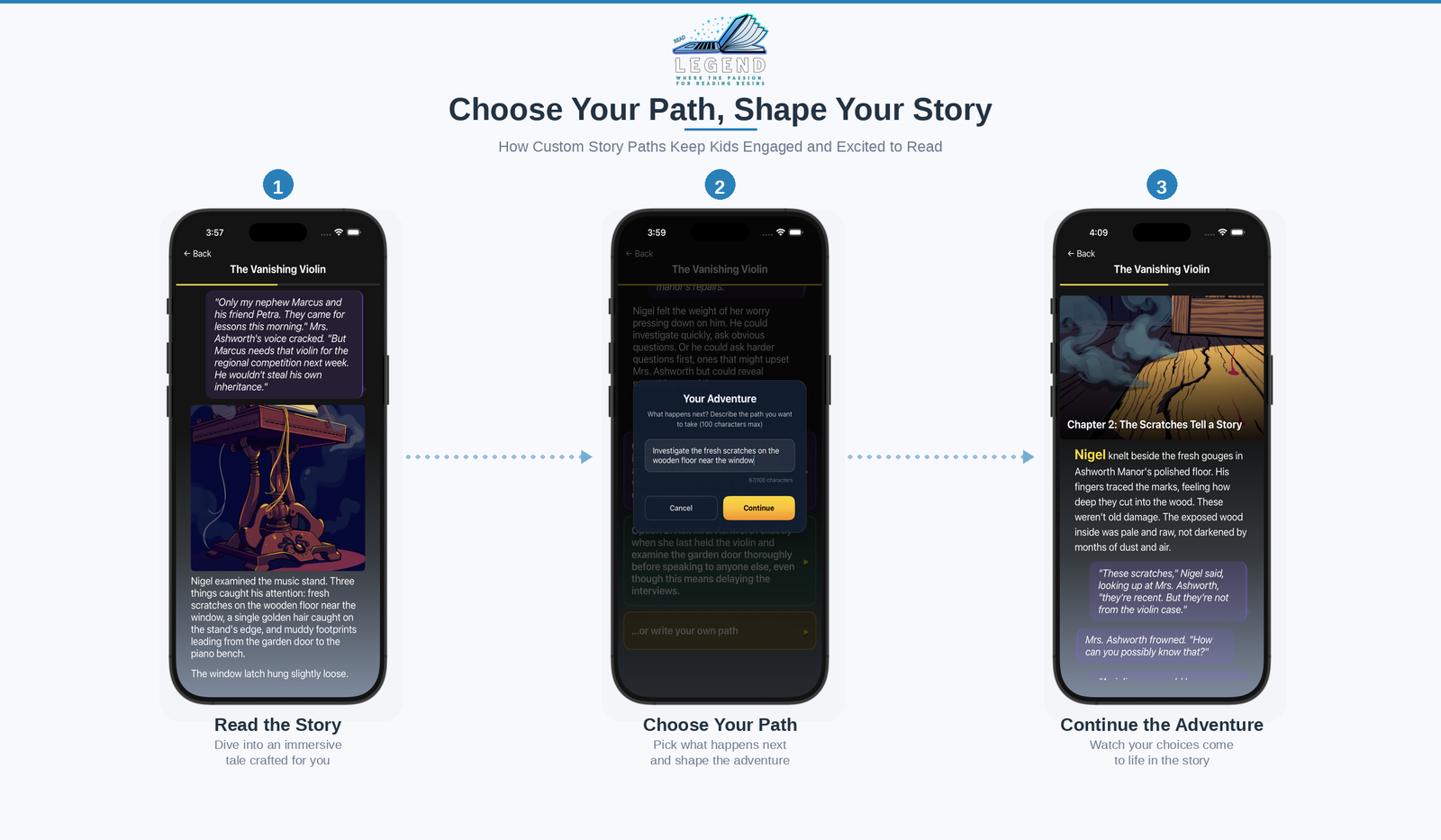
Let’s look at how this plays out in practice. Imagine a young reader diving into “The Vanishing Violin,” a mystery story on ReadLegend designed for detective enthusiasts.
The Setup: Chapter 1 introduces our protagonist arriving at the grand Ashworth Manor, where a priceless Stradivarius violin has mysteriously disappeared. The chapter is rich with atmospheric details—the creaky floorboards, portraits watching from the walls, and various characters with potential motives.
\p>As the reader progresses, they encounter specific clues woven into the narrative:
- Fresh scratches on the wooden floor near the library window
- A strand of golden hair caught on the music stand
- Muddy footprints leading from the garden entrance
- The manor’s cat acting strangely around the conservatory
The Decision Point: At the end of Chapter 1, the “Your Adventure” popup appears, asking: “What happens next? Describe the path you want to take (100 characters max).” ReadLegend suggests two options: “Question the suspicious butler about his whereabouts” or “Search the garden for more clues.”
But our attentive reader noticed something specific—those fresh scratches near the window. They type their custom path: “Investigate the fresh scratches on the wooden floor near the window.”
The Continuation: Chapter 2 begins based on this choice. The narrative acknowledges the reader’s decision, following the protagonist as they kneel to examine the scratches more closely. This investigation reveals that something heavy was recently dragged across the floor toward the window, opening a new line of inquiry the preset options wouldn’t have explored.
Notice what happened here: the child engaged in close reading, identifying a detail that intrigued them, made a logical deduction about its significance, and took ownership of the investigation. This is interactive reading engagement at its finest—the story became theirs through active participation.
The Educational Foundation: Why Agency Matters
The power of custom story paths isn’t just anecdotal—it’s grounded in educational research about motivation, agency, and learning. When children have genuine control over their learning experience, several documented benefits emerge.
Autonomy is one of three fundamental psychological needs identified in Self-Determination Theory, alongside competence and relatedness. When children exercise real choice—not just selection from a predetermined menu—their intrinsic motivation increases dramatically.
This translates to:
- Greater persistence when reading challenging material
- Increased time spent engaged with stories
- Better retention of narrative details and plot points
- More positive associations with reading as an activity
- Transfer of analytical skills to other reading contexts
The custom path feature also supports differentiated learning. A younger or struggling reader might choose simpler, more straightforward paths, while an advanced reader can explore complex narrative threads. The same story adapts to different skill levels naturally, without the stigma of separate “easy” and “hard” versions.
Practical Tips for Parents: Maximizing the Experience
If you’re exploring ReadLegend’s custom story paths with your children, here are some strategies to deepen the experience:
- Ask “what do you notice?” before decision points. This encourages active observation of details.
- Explore different paths together. Read the same story multiple times, trying different custom choices to see how the narrative adapts.
- Let siblings take turns choosing paths when reading together. This builds turn-taking and compromise skills.
- Discuss predictions: “If you choose that path, what do you think will happen? Why?”
- Celebrate creative thinking, even when paths lead to unexpected outcomes. The goal is engagement and imagination, not “correct” choices.
- Use it as writing practice. The 100-character limit encourages concise, clear expression—a valuable writing skill.
Remember, there’s no wrong way to use this feature. Some children will carefully analyze every detail before choosing, while others will follow their impulses and learn from where those paths lead. Both approaches build different valuable skills.
Beyond Entertainment: Building Lifelong Readers
The ultimate goal of any children’s reading platform isn’t just to entertain in the moment—it’s to build positive associations with reading that last a lifetime. When we think about what creates lifelong readers, several factors consistently emerge: autonomy, competence, enjoyment, and social connection around books.
Custom story paths address all of these factors simultaneously. Children exercise autonomy by directing the narrative. They build competence through the analytical skills required for meaningful choices. They experience enjoyment from the creative freedom and surprise. And they forge social connections through collaborative reading sessions.
Perhaps most importantly, this feature meets children where they are in our digital age. Today’s kids are used to interactive experiences, to content that responds to their input, to being participants rather than passive consumers. Custom story paths honor this reality while channeling it toward literacy and learning.
Conclusion: The Future of Reading Is Co-Creation
The evolution from traditional books to choose-your-own-adventure to fully custom story paths represents more than technological progress—it represents a philosophical shift in how we think about reading itself. Stories are no longer something that happens to readers; they’re something readers actively create.
This shift has profound implications for interactive reading engagement. When children become co-authors of their reading experience, they invest more deeply, think more critically, and engage more joyfully. They read for clues because those clues matter for their decisions. They debate story directions with siblings because everyone’s ideas deserve consideration. They return to stories again and again because each reading can be entirely different.
For parents seeking to build strong readers in an age of digital distraction, platforms like ReadLegend offer a promising path forward—one where the interactivity kids crave serves the literacy goals parents cherish. It’s not about choosing between traditional reading values and modern engagement; it’s about finding where they complement each other perfectly.
The next time your child sits down with a story, imagine if they could take it anywhere they wanted. That’s not just reading—that’s reading transformed into creative adventure, collaborative discovery, and genuine co-creation. And that might just be the future of how we raise readers who love reading.